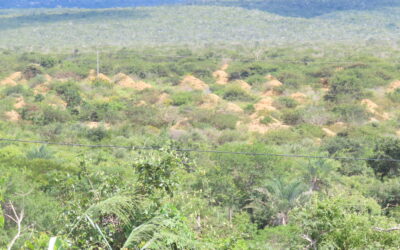

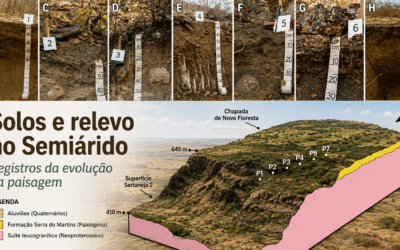
Study published in Catena shows how soils and landforms record different stages in the evolution of a sedimentary plateau in the Brazilian semiarid region. Deeply weathered Ferralsols, shallow soils, ferruginous crusts, and alluvial deposits reveal the interplay among pedogenesis, erosion, sedimentation, landform stability, and environmental change over time.
Latossolos
Latossolos (Ferralsols) in Brazil’s Northeast semiarid region: what does this “contradiction” reveal?
Why do Latossolos occur in Brazil’s Northeast semiarid region? Drawing on the paper by Grace Bungenstab Alves, this text shows how reading soil and relief together reveals both legacies from wetter phases and more recent landscape reorganization. Two examples illustrate the argument: Vertisols with Holocene OSL ages and the Latossolo–Planossolo transition. Together, they highlight that separate inventories of soils and landforms do not explain processes, and that transition zones often hold the key evidence for interpretation.