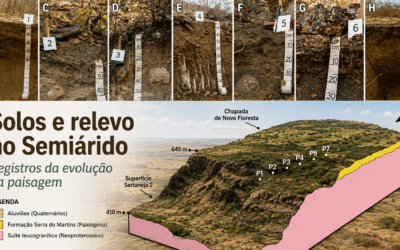

A newly published article in the European Journal of Soil Science, with the participation of Grace B. Alves, argues that the soil profile remains an indispensable tool for understanding soil genesis, functioning, and degradation. The paper shows that describing horizons, layers, and morphological features allows researchers to interpret processes that cannot be captured by surface-only sampling. This makes soil profile description essential for sustainable land management, environmental conservation, and the reconstruction of landscape history. The article also warns about the weakening of training in pedology and advocates for the integration of field observation, sensors, artificial intelligence, and digital soil mapping.
Processes and slope forms: e-book brings together studies on landforms and erosion from XV SINAGEO
An e-book edited by Grace Bungenstab Alves brings together studies on erosion, landforms, and slope dynamics across different regions of Brazil, highlighting the contribution of geomorphology to understanding landscapes in transformation.
Teacher education and PIBID in times of precarization: critical reflections and possible pathways
This post critically examines teacher education and the PIBID program in times of precarization, drawing from the book Professor S/A and related works developed within the Colapso/UFBA research group. It discusses how recent changes in public policies have negatively impacted teacher training, while also highlighting experiences and reflections that point to collective resistance and alternative pathways. The publication brings together contributions on the effects of flexible accumulation in education, connecting teaching, research, and political action within the field of Geographic Education.
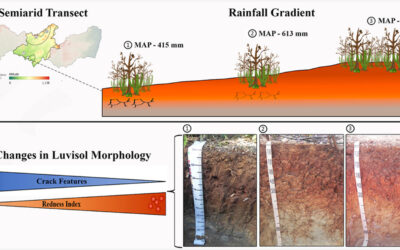
Rain as a driver of soil transformation in Brazil’s Semiarid Region
Study reveals how variations in precipitation affect the color, structure, and mineralogy of Luvisols in Brazil’s semi-arid region, with implications for soil fertility and agricultural potential