

 Português
  English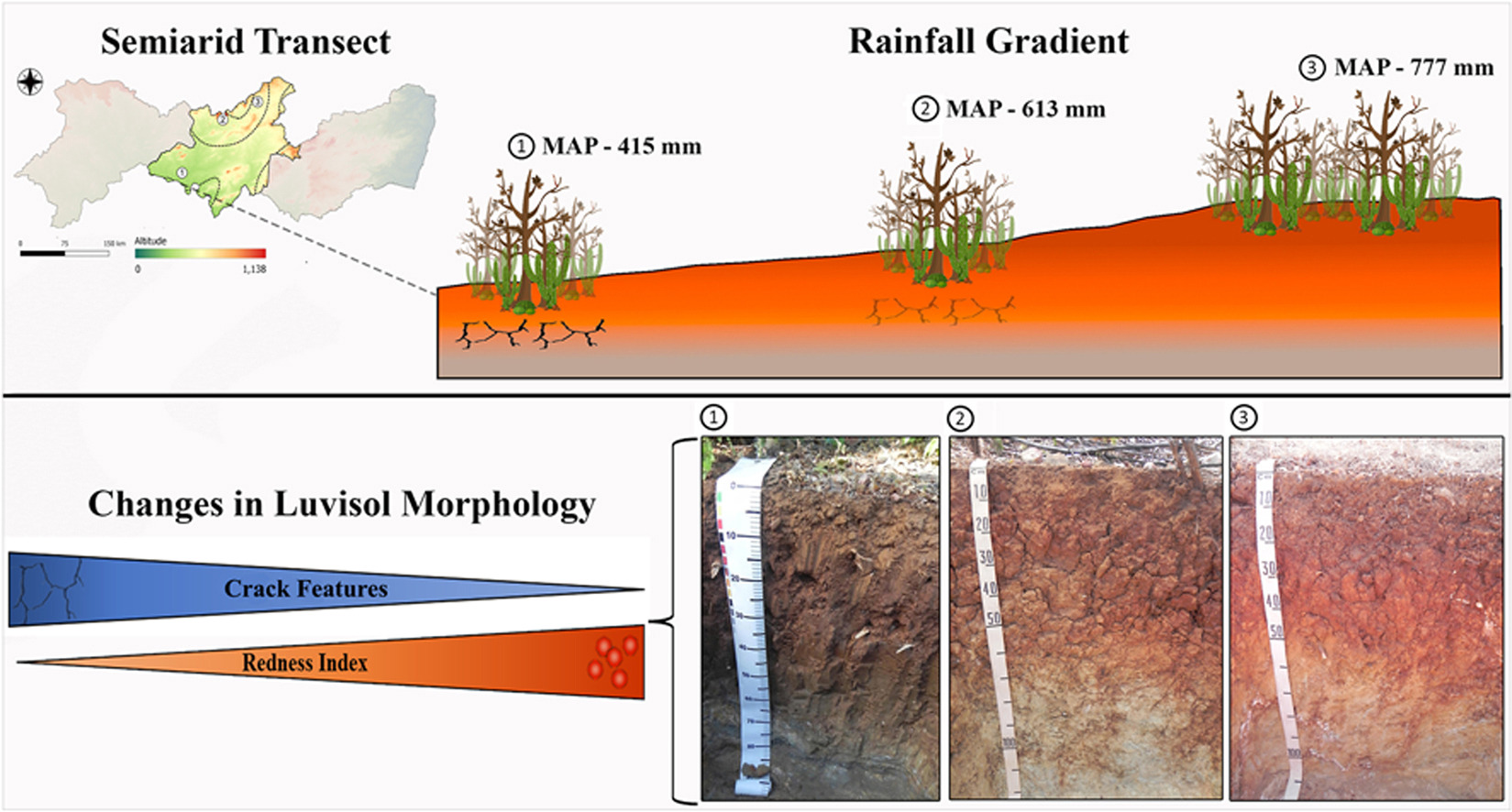
Study reveals how variations in precipitation affect the color, structure, and mineralogy of Luvisols in Brazil’s semi-arid region, with implications for soil fertility and agricultural potential
In Brazil’s semi-arid hinterland, where agriculture is shaped by scarce and irregular rainfall, soil science may offer pathways to more sustainable land use. In a new study published in the Journal of South American Earth Sciences, a team of researchers — including Grace B. Alves, from the COLAPSO research group — investigated how variations in rainfall regimes influence the formation and evolution of Luvisols in the Borborema Province, Pernambuco.
The study compared three Luvisol profiles developed from amphibolite bedrock under mean annual precipitation ranging from 415 mm to 777 mm. Results show that increased rainfall intensifies in situ clay formation (argillation), iron oxide accumulation (rubification), and mineralogical transformations without triggering clay translocation.
Figure
Morphological variations in Luvisols along a precipitation gradient in Borborema Province (PE). The semi-arid transect reveals increasing rubification (redness index) and decreasing shrink-swell features as rainfall (Mean Annual Precipitation – MAP: 415 to 777 mm) increases. Soil profile photographs highlight structural and chromatic contrasts observed in the field.
Source: Silva, V.R.F. et al. (2024). Impact of climate on mineralogy and formation of Luvisols in Borborema province, northeastern Brazil. Journal of South American Earth Sciences, 149, 105197. https://doi.org/10.1016/j.jsames.2024.105197
In wetter environments, soils exhibited redder hues, higher organic carbon content, and a predominance of kaolinite, a mineralogy associated with greater structural stability and reduced cracking risk. In drier regions, expansive minerals like smectites dominate, leading to shrinkage cracks and limitations for mechanized farming.
The study shows that even subtle differences in moisture regimes can significantly affect the mineralogy and morphology of tropical dry soils. These insights are crucial for assessing agricultural potential, informing land management strategies, and anticipating landscape transformations in the context of climate change.
The article contributes to an ongoing research line focused on the interplay between climate, parent material, and pedogenetic processes in semi-arid environments, with potential for comparative studies across other dry tropical regions.
📄 Cited article:
Silva, V.R.F. et al. (2024). Impact of climate on mineralogy and formation of Luvisols in Borborema province, northeastern Brazil. Journal of South American Earth Sciences, 149, 105197. https://doi.org/10.1016/j.jsames.2024.105197