

 Português
  English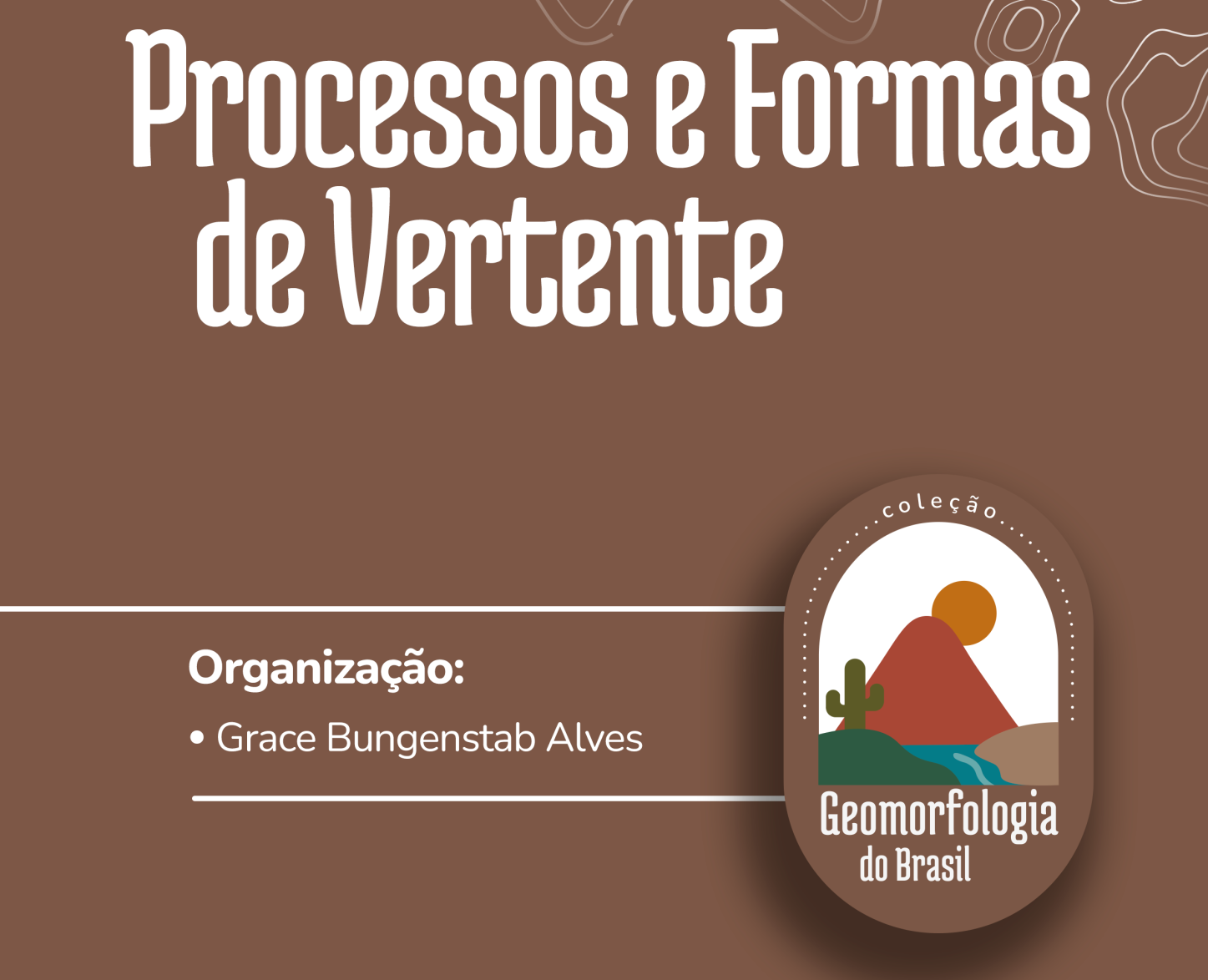
An e-book edited by Grace Bungenstab Alves brings together studies on erosion, landforms, and slope dynamics from different regions of Brazil, highlighting the contribution of geomorphology to understanding landscapes in transformation.
A volume on landforms, erosion, and landscape
The e-book Processes and Slope Landforms, edited by Grace Bungenstab Alves and published in 2026 by Eduern, brings together five chapters focused on the analysis of landforms, erosion, and surface dynamics in different regions of Brazil. The book is part of the Geomorphology of Brazil collection and stems from papers presented at XV SINAGEO (the National Symposium on Geomorphology).
More than a thematic collection, the volume shows how the study of slopes remains central to understanding landscape evolution. By bringing together studies with distinct empirical approaches, the book highlights the range of perspectives currently shaping Brazilian geomorphology.
Five chapters, five analytical perspectives
The first chapter, “A morfometria do relevo e a sua relação com a ocorrência de feições erosivas lineares em área de cuesta: nascentes do Rio Cabeça (SP)” (Relief morphometry and its relationship with the occurrence of linear erosive features in a cuesta area: the headwaters of the Rio Cabeça, São Paulo State), by Higor Lourenzoni Bonzanini and Cenira Maria Lupinacci, examines the occurrence of rills, ravines, and gullies in a cuesta landscape. Its aim is to understand how slope gradient and relief energy classes relate to the concentration of these erosive features. In doing so, the study highlights the potential of morphometric analysis to identify terrains more susceptible to erosion and to support environmental planning.
In the second chapter, “Paisagens encouraçadas na Bacia Sedimentar Bauru: dinâmica geomorfológica de um morro testemunho em Bandeirantes, Mato Grosso do Sul” (Armored landscapes in the Bauru Sedimentary Basin: geomorphological dynamics of an outlier hill in Bandeirantes, Mato Grosso do Sul), Viviane Capoane and Patricia Colombo Mescolotti investigate the evolution of an outlier hill. Here, the focus is on the role of ferruginous duricrusts in protecting landforms and controlling erosive processes in the sandstone substrate. The chapter therefore helps explain how these hardened covers preserve residual landforms and shape geomorphological dynamics.
The third chapter, “Variáveis geomorfométricas da bacia Colônia Antônio Aleixo (Manaus-AM): implicações para susceptibilidade erosiva” (Geomorphometric variables of the Colônia Antônio Aleixo basin, Manaus: implications for erosion susceptibility), by Armando Brito da Frota Filho and Antonio Fábio Sabbá Guimarães Vieira, seeks to identify the erosion susceptibility of an urban basin. To do so, the authors combine drainage parameters, slope, basin shape, and the occurrence of gullies. In this way, the study shows how urbanization and landforms configuration contribute to environmental vulnerability.
In the fourth chapter, “Geomorfologia da paisagem no semiárido nordestino, Maciço da Serra Negra (SE): correlação entre os processos superficiais e depósitos aluviais e coluviais” (Landscape geomorphology in the northeastern semiarid region, Serra Negra Massif, Sergipe: correlation between surface processes and alluvial and colluvial deposits), Iasmin Teles Carvalho, Daniel Rodrigues de Lira, and Paulo Vitor Souza dos Santos analyze the relationship between surface processes and the formation of alluvial and colluvial deposits. The study contributes to understanding regional geomorphological evolution by showing how inherited structures, present-day dynamics, and sediment deposition interact in shaping the landscape.
Closing the volume, the chapter “Análise multivariada de feição erosiva do tipo voçoroca no contexto urbano e rural nos estados do Maranhão e Piauí” (Multivariate analysis of gully erosion features in urban and rural contexts in the states of Maranhão and Piauí), by Gilberlene Serra Lisboa, Wellynne Carla de Sousa Barbosa, José Fernando Rodrigues Bezerra, and Antonio José Teixeira Guerra, analyzes the spatiotemporal evolution of gullies in urban and rural areas. To this end, it correlates erosive dynamics with the physical properties of soils and with land use and land cover. The chapter shows how anthropogenic factors and distinct pedological characteristics condition the intensification of these processes in different settings.
Why studying slopes matters
Taken together, the chapters show that studying slopes goes beyond simply describing landforms. In practice, it means investigating how geological structure, climate, vegetation cover, hydrosedimentary dynamics, and human action combine to produce, accelerate, or contain erosive processes.
In this sense, the e-book reinforces the importance of integrated approaches for understanding landscapes in transformation. This volume helps give visibility to a research agenda that is highly relevant to Physical Geography, with direct implications for soil conservation, environmental planning, and the interpretation of surface dynamics in Brazil.
Relevant reading for Brazilian Physical Geography
The volume will interest researchers, students, and professionals working with slopes, soils, landscape, environmental susceptibility, land use, and territorial management. By bringing together studies from different regions of the country, the book reinforces the importance of geomorphology for interpreting present-day processes and contemporary environmental challenges.
Bibliographic reference
Alves, Grace Bungenstab (ed.). Processes and Slope Landforms. Mossoró, RN: Edições UERN, 2026. 86 p. (Geomorphology of Brazil collection). ISBN 978-85-7621-578-3. Available at: https://portal.uern.br/eduern/livros_/processos-e-formas-de-vertente-vol-ii/. Accessed on: Apr. 7, 2026.