

 Português
  English
A newly published article in the European Journal of Soil Science argues that observing, describing, and interpreting soil profiles remains essential for understanding how soils form, function, and respond to environmental degradation.
The paper, titled “Soil Profiles: A Window Into Soil Genesis and Degradation”, brings together an international group of researchers and includes the participation of Grace Bungenstab Alves, professor at the Federal University of Bahia and researcher at the COLAPSO – Nature and Society Research Group. Published as part of the 75th anniversary of the European Journal of Soil Science, the article reflects on the role of pedology in contemporary soil science.
Its main argument is clear: a soil profile is not simply a vertical section opened in the ground. It is a way of reading the history of soils and landscapes.
Soil does not end at the surface
Many environmental and agricultural assessments still focus on the upper 20 or 30 centimeters of the soil. This approach is useful for some purposes, but it is not enough to understand the soil system as a whole.
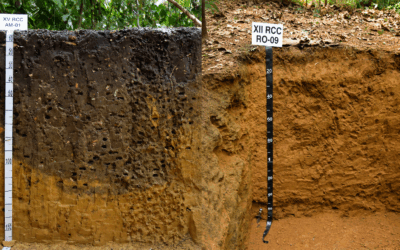
Soil horizons, layers, colors, structures, roots, concretions, redoximorphic features, cemented materials, and subsurface constraints reveal processes that cannot be captured by surface-only sampling. These features help explain water movement, rooting conditions, fertility, degradation, carbon storage, and the capacity of soils to provide ecosystem services.
The article shows that some of the most important limitations to land use and ecosystem functioning occur below the surface. Subsoil horizons may restrict root growth, reduce water infiltration, affect nutrient availability, and control the way soils respond to environmental change.
A scientific language at risk
One of the strongest points of the article is its warning about the decline of field-based pedology. The authors argue that soil profile description has become, in many contexts, a “lost language” within soil science.
This is not a nostalgic defense of old methods. The argument is more precise: digital soil mapping, proximal sensing, spectroscopy, machine learning, and artificial intelligence have greatly expanded the analytical capacity of soil science. However, these tools do not replace direct field observation.
They depend on field-based expertise for validation, calibration, and interpretation.
In other words, the future of soil science should not be built on a false opposition between traditional pedology and digital technologies. It requires both.
Pedodiversity, landscape, and sustainable land management
The article also emphasizes the importance of pedodiversity: the diversity of soil types, properties, and horizon development within a given region or landscape.
Pedodiversity results from the interaction of parent material, climate, relief, organisms, and time. For this reason, soil profiles cannot be understood as isolated objects. They are part of slopes, catenas, geomorphic surfaces, drainage systems, and broader landscape dynamics.
This perspective is central to sustainable land management. Decisions about agriculture, conservation, restoration, and environmental planning cannot rely only on generalized maps or surface indicators. They require an understanding of how soils vary in space and depth.
This discussion connects directly with research developed by the COLAPSO group, especially on soil-landscape relationships, pedogenesis, geomorphology, geodiversity, and environmental change.
Soil profiles as archives of landscape change
The article also highlights the role of soil profiles in landscape reconstruction and geoarchaeology.
Soils may record erosion, deposition, stability phases, human occupation, climate change, and long-term environmental transformations. In this sense, soil profiles can function as archives of landscape memory.
In some contexts, this memory is preserved in horizons, structures, materials, and biological or chemical features. In others, the loss of soil memory may indicate erosion, instability, or degradation.
This approach is particularly relevant for tropical and semiarid landscapes, where old soils, reworked materials, weathering profiles, and geomorphic surfaces may reveal complex histories of environmental change.
Soil literacy, monoliths, and museums
The article also calls attention to soil literacy.
Soils are rarely central topics in natural history museums, school curricula, or public environmental debates. This absence limits broader social understanding of one of the most important systems for life on Earth.
Soil monoliths, profile collections, soil museums, and educational exhibitions can help make the invisible visible. They show that soils are diverse, dynamic, historically formed, and deeply affected by human action.
In this sense, describing soil profiles is not only a technical practice. It is also a way of communicating science and strengthening public awareness of soils.
Why this article matters
The main message of the paper is straightforward: in a world facing soil degradation, climate change, biodiversity loss, and food insecurity, soil profile description remains a scientific and societal necessity.
Without soil profiles, we lose part of our ability to interpret deep processes, diagnose environmental constraints, plan land use, monitor degradation, and understand the history of landscapes.
By contributing to this international publication, Grace Bungenstab Alves takes part in a central debate in contemporary soil science: how to train new generations of researchers capable of combining field observation, conceptual rigor, and digital technologies.
More than a defense of classical pedology, the article is a call to reinvest in the ability to read soil profiles as windows into soil genesis, degradation, and landscape memory.
Reference
SCHILLACI, Calogero; ALVES, Grace B.; BAYAD, Mohamed; BONDI, Giulia; BURN, Christopher R.; BREURE, Timo; CERTINI, Giacomo; CHEN, Songchao; D’AMICO, Michele E.; et al. Soil Profiles: A Window Into Soil Genesis and Degradation. European Journal of Soil Science, v. 77, e70322, 2026. https://doi.org/10.1111/ejss.70322
Portuguese version available here:
https://colapso.ggf.br/perfil-de-solo-genese-degradacao-paisagem/